

Navigating Desire
some thoughts on being an Internet Mother

My son, two and a half, walks from his bedroom into the kitchen and asks, “Mama, what’s it called?”
I look into his squinting eyes, searching for the invisible story playing in his imagination and pluck the word he’s looking for out of the air and hand it to him.
“Aquarium?”
“Yea! Aquarium!” he shouts.
This is my superpower – knowing exactly what he’s referring to without any context to his question. I turn to an invisible audience and dramatically bow every time this happens.
So goes the language of intimacy, formed between lovers, mothers and children, sometimes even between Creator and created. It’s a language developed with time and devotion, shaped through the lens of contemplative beholding.
Here’s what I’ve found to be true: such intimacy can’t be built when you’re being watched, evaluated, or consumed by others. It flourishes in private, not in public. Those things that unfold in the dark womb of our non-public lives are the things that make a life.1 In The Time Before Children I knew this to be true in the way that you ‘like’ aspirational quotes on Instagram. But then my children came along and this vague belief became a stone-cold conviction. One might consider this clarity a gift. After all, re-prioritizing our lives in favor of the slow, quiet, and hidden is surely a virtue. But the pursuit of virtue is rarely a tidy or pleasant experience.
What I’m trying to tell you is that I once felt totally at ease navigating the public online world. I thought very little about the existential impact of building, maintaining, and growing a digital presence. The public and private were blurred and I had zero feelings about it.
But then a new creative work embedded itself in the spongy lining of my uterus and proceeded to literally consume me. Almost overnight I felt all my ambition and online aspirations evaporate. People told me not to worry, it’ll be back, but it never returned. At least, not in the form it had taken before I became a mother. Being thrust into the relentless bodily needs of a tiny human snapped me out of my digital delusions: the life that really mattered was right here in front of me asking me “Mama, what’s it called?” not in the infinite chasm of the internet.
For the last couple years, I’ve largely given myself over to the gravitational pull of love turning me towards private domestic life. I had lived a good, fun public online life, and I was more than ready to let that go to grow things in the dark – to cultivate the conditions where I could thrive and so could my family. I found the physical presence of other humans infinitely more intoxicating than a glowing screen.


The internet is not known to be a place of nuance and complexity. It’s also not really known to be a place where women and girls can flourish. And yet, here I am writing to you on a social media platform. Over there are some yoga videos I created that I think you’ll really enjoy. And, at this very moment, I’m 93 unread messages behind in a group text with dear friends I met on Mark Zuckerberg’s internet.
For all the knee-jerk animosity I feel towards the noisiness, monetization, and predatory vibes of the online world, it has connected me with some very cool people and has given my creativity a place to flourish.
So I keep asking:
What of my private life should be available for public display and consumption?
Everything? Some things? Nothing?If the answer is “some things,” then how do I determine which ones? How do I not live every private moment wondering how this will fare on social media?
At what point do I cross a line and start using my private life to advance my public life, making my children’s antics and marital frustrations fodder for followers?
How will I know if I’m using God or my family in service of my selfish ambition and vain conceit?
How will I find any success if I don’t?
This Spring I read Mandy Smith’s book The Vulnerable Pastor. In it, she relays a story about Mother Teresa:
When the brilliant ethicist named John Kavanaugh went to Calcutta to work for three months at ‘the house of the dying’ in Calcutta, he was seeking a clear answer as to how best to spend the rest of his life. On the first morning there he met Mother Teresa. She asked, “And what can I do for you?” Kavanaugh asked her to pray for him.
“What do you want me to pray for?” she asked. He voiced the request that he had borne thousands of miles from the United States. “Pray that I have clarity.”
She said firmly, “No, I will not do that.” When he asked her why, she said, “Clarity is the last thing you are clinging to and must let go of.” When Kavanaugh commented that she always seemed to have the clarity he longed for, she laughed and said, “I have never had clarity; what I have always had is trust. So I will pray that you trust God.”2
In trying to discern what I should do – whether and how I want to show up online in a true, beautiful, sustainable way – I find myself hoodwinked, once again, by the belief that clarity must come first. I wait for it to descend like the tongues of fire on Pentecost – all of a sudden I’ll be supernaturally empowered to speak the language of the internet and I will know how to navigate this confusing world with power and purpose.
But instead of tongues of fire, I hear the faint echo of a Psalm I’ve read a hundred times: “You know me…Even before a word is on my tongue, O Lord, you know it completely.” (Psalm 139:4)
I think of my son, running into the kitchen asking me for the word he can’t think of but trusts that I know and will give to him. In his search for clarity, for a word that embodies the thing he sees in his imagination, he runs to me. Perhaps this is a picture of what it’s like to be known by God…
I turn to an imaginary audience and dramatically bow.
Because up until this moment I had read this Psalm with fear and trembling: God knows me which means God knows what a failure I am. I better confess sooner, better, more frequently, because God knows all. I need to get it together, be on top of things, say the right thing. I read it through that grossly murky lens of bad theology, childhood wounds, and cultural scripts about being a good girl. Instead of bringing comfort, this Psalm came with a heaping side of shame.
But God knows me in the way that a mother knows her child – bone of my bone, flesh of my flesh. God knows the word I’m looking for but can’t find because we speak the language of love developed over years of shared experiences, active listening, and attuned presence. I can speak my vague question and trust that God knows.
Does God get a thrill of delight every time this happens?
The Bible tells me so.
I set out with the intention of convincing you that I do now, in fact, know how to show up in the (online) world, but after spending weeks trying to write something coherent and compelling I freely admit, I have no idea. I don’t know how to “bring you along on my journey from Online Christian Yoga Teacher to Theology & Motherhood Writer.” I don’t know how to make reels. I don’t know how to digitally engage in a way that feels sustainable and not de-humanizing.
And here’s the truest (scariest) question: I don’t know if I want to.
Do I really want to spend my limited time and energy on the internet? Do I want to share my scattered self with the world?
Desire feels kaleidoscopic these days…
I want to use the bathroom alone // I want to be the first thing my child sees when they wake up in the morning
I want to make art // I want to sleep
I want to be in the room where it happens // I want to live a slow, quiet life where interruptions don’t derail me
I want to be articulate and profound // I want to be attuned and present
And also…
I want to be a published author. I want to gather in rooms around the world and practice embodied faith. I want the stories of women to be shared and to shape our liturgies, lessons, and lives. I want my daughter to have a tangible vision of a woman who takes herself and God seriously. I want to imprint on my body, the experience of trying and failing, or trying and falling flat, and laughing at the delight of trying anyway.
I want to desire trust more than clarity.
I want to embrace my humanity.
I want to know my children so intimately that before a word is on their tongue, I know it completely.
I want to show them – and you – that this is what God’s trustworthy love is like.
Can such loving desires flourish in public and in private?
I’m still asking God.
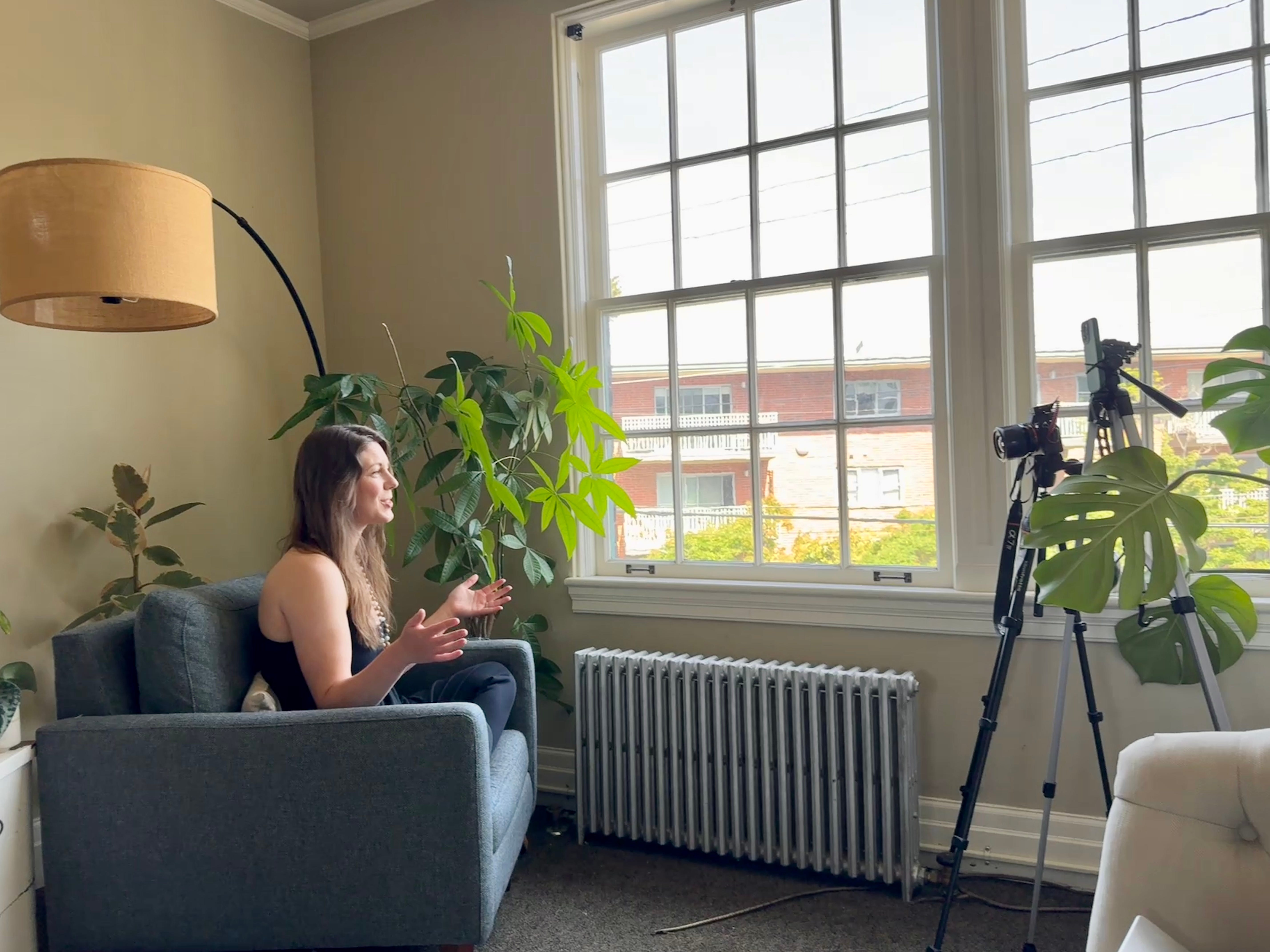
Mostly, when I speak of public I speak of online – that particularly 21st century work of building a brand on the internet. When I speak of private I speak of the domestic, the mostly hidden work of caretaking the people, space, and land we call home.
Brennan Manning first shared this story in his book Ruthless Trust.
Thank you, Caroline. I don’t know if this brings relief, encouragement or something else, but I still find myself swinging between these seemingly polar opposites, even in my grandmother hood. My experience is that there is less and less clarity as we age. Indeed, the intense transitions and disruptions of mid-life have required an ever deepening trust in God. I’ve simply had no choice! I wrestle every day with the desires to either curl up with a good book and enjoy the stillness and peace in my home, or to get busy building “my” ministry. Can’t say I’ve found how to reconcile them. I haven’t, but I suspect I’ll find it in the presence of Jesus, that’s usually where everything comes clear. Blessings to you and your beautiful family.
The internal feud between all of our desires is- at times- debilitating. Especially after the breaking that is motherhood.
Thank you for your words!
Also that line about clarity with mother Teresa…. Ruined my prayers from the last like 6 years ha
Getting that book next!