

The Missing Mother
a tale as old as time

A fairy tale is a story that is false on the outside but true on the inside.
I first came across this definition in Lisa Marchiano’s book, Motherhood: Facing and Finding Yourself where she examines myths from around the world through the lens of Jungian depth psychology. Yes, you should read it. It was the first book I read that actually helped me make sense of my experience of becoming a mother. Turns out the existential unraveling I was experiencing, though utterly terrifying, wasn’t all that unique. For centuries, people around the world have been trying to make sense of the fraught experience of being a woman and mother. They wove their fears and triumphs into stories with mythical creatures in fairy tale settings that reflect the complicated experiences of being human. They may be false on the outside, but they remain profoundly true on the inside.
One of the enduring features of the fairy tales that remain alive in our cultural consciousness today is the theme of The Missing Mother.
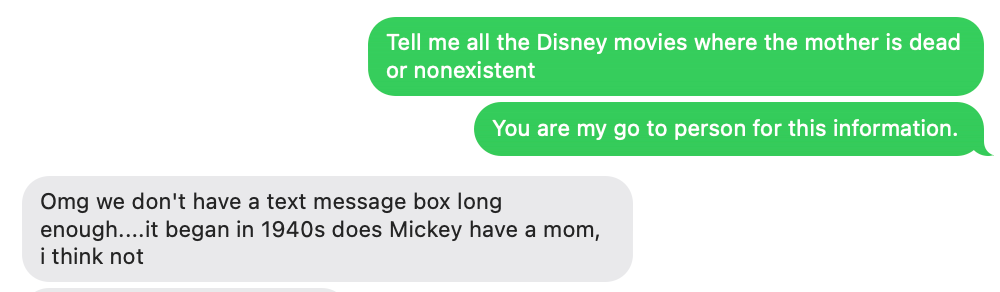
The Little Mermaid
Aladdin
Beauty and the Beast
Pocahontas
Snow White
Cinderella
Rapunzel
Once you see it, you can’t unsee it. The mothers in these stories are either dead, mysteriously absent, or replaced by a stepmother who acts as a foil to the virtue of the leading female character. If there is a mother figure, she is evil, wicked, and corrupted by power.
Many of these modern Disney movies have clearly traceable lines to fairy tales told long before the advent of television.
When I’m feeling charitable, I wonder if the reason so many of these stories lack a living and present mother is because back when these myths first emerged, the mother really was dead. Mortality rates for women were high and childbirth was extremely dangerous. Many women did not survive and if they did, they endured lifelong complications and injuries. That kind of devastating loss imprints itself on a child, and that kind of loss was common. Storytelling is our human attempt at making meaning of the world and the bitter suffering we’re handed; these stories reflect that.
But I don’t always feel so charitable. Often I feel quite cynical. Though the opening chapters of Genesis affirms the equal value and dignity of women and men – both after all reflect the image and likeness of God – people have long found a way to diminish the value and contributions of women. This is especially true in the church. The Complementarian/Egalitarian debate we’re having today is a relatively modern one with both camps fundamentally agreeing in the equality of women and men but debating their roles within the church. For most of history though, women were not considered equal to men. Women were property, a thing to own and dominate, a character to be easily dispensed of in a story that doesn’t really need her anyway.
The myth of The Missing Mother endures.
From early childhood, our imaginations have been shaped by this fairy tale feature. We are a people formed by stories that do not stop to question why the mother is missing and what is lost as a result.
Recently I took my son to an overpriced play cafe. After about five minutes exploring the play equipment, he decided he’d rather sit and read books (which, I pointed out, we could do for free at the library, but he remained unpersuaded by such logic). He collected a pile of books and climbed into my lap. At the top of the pile was a book called, Princess Grace and the Lost Kitten. I turned to the first page and started reading:
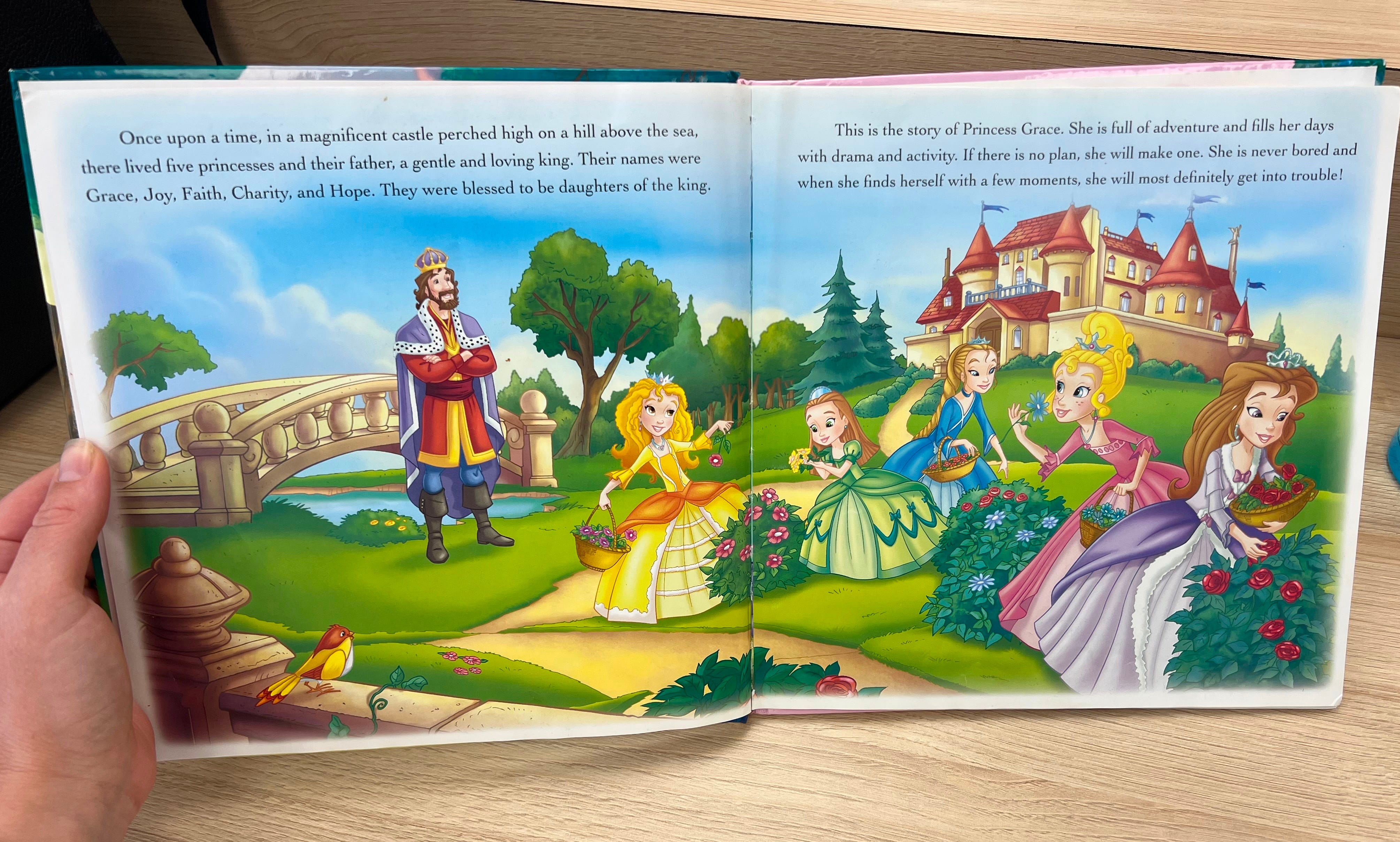
“Once upon a time, in a magnificent castle perched high above the sea, there lived five princesses and their father, a gentle and loving king.”
I rolled my eyes. Here we go again, another story with a Missing Mother.
“Their names were Grace, Joy, Faith, Charity, and Hope. They were blessed to be daughters of the king.”
WAIT WHAT?!
THIS WAS A CHRISTIAN BOOK?!
I’m always surprised to stumble on Christian artifacts out in the wild in a city like Seattle, but that’s not what surprised me.
Here was a children’s book purporting to retell a story Jesus once told about a missing sheep. Nothing about it was subtle: The “gentle and loving king,” is God, our King with a capital ‘K.’ The five princesses are us humans, the beloved children of God, bestowed with the honor and dignity that comes with being a Daughter (or Son) of the King. The soon-to-be-lost kitten is the lost sheep Jesus describes in Matthew 18 and Luke 15, which is to say, the lost kitten/sheep is also us.
But I could not look at this page and not see something – some one – glaringly missing.
(I think you know where I’m going with this…)
WHERE IS THEIR MOTHER?!?!?!?!?!
Are we just meant to take for granted that this scene of a father with his daughters is sufficient and complete?!
Should we not question the absence of the woman who carried each girl in her body, birthed her into the world, and fed her until she could feed herself?!
Are we to believe these girls are content without a mother or mother figure to help them navigate girlhood and womanhood?! That their lives aren’t marked by a deep and profound grief for all that’s lost because of their Missing Mother?!
Now I know there are plenty of books, particularly Christian children’s books, that are problematic. One could devote an entire doctoral thesis to investigating the faulty theological framework of this genre. But this book is by no means unique. It is entirely a product of the cultural and theological imagination we have around mothers and the maternal heart of God.
We do not question whatsoever the absence of a mother or mother figure. We take for granted that a scene like the one above is good and right.
We are a people formed by stories that do not stop to question why the mother is missing and what is lost as a result.
If a fairy tale is a story that’s false on the outside but true on the inside, then what might this enduring theme of The Missing Mother reveal to us and about us?
When it comes to righting this wrong, I am not as progressive as some might imagine.
‘Heavenly Mother’ feels strange on my lips. I do not pray to the Mother, Son, and Holy Spirit. It’s important to me to remain Biblically faithful (which is wildly open to interpretation and something I’m continually excavating in seminary).
But here are three things I do to re-form my heart to love and be loved by a God who mothers as well as fathers:
I use gender neutral language as much as possible. Instead of referring to God as ‘He,’ I turn to another name for God that the Scriptures give us - Creator God, God of Mercy, Loving God, God of the Angel Armies. I do this not to be pedantic but to enlarge my own imagination and the imagination of my children. I want to inhabit and transmit a prophetic imagination1, and that means turning to the vivid language of Scripture to enlarge my understanding of the names and images of God.
When reciting an ancient creed or a communal liturgy and God is referred to as ‘Father,’ I speak the name boldly and truthfully because I believe in the power of communal confession and I believe ‘Father’ to be a true and right name for God. But when I speak ‘Father,’ I also imagine ‘Mother,’ because I believe God is both Father and Mother. God’s love is both paternal and maternal and also, far beyond my binary concepts of parental love. Which is to say that God is both imminent and transcendent, knowable and inscrutable, intimate and mysterious.
In my own daily experience of mothering, I strive to practice the presence of God as Brother Lawrence articulates. This means resting my awareness on God’s withness through the breakfast making, story listening, tear wiping, play date scheduling, boundary holding, anxiety calming, and question answering that occupies a single hour of mothering. My son calls out, ‘Mama’ incessantly, as if he were a bat using the name as echolocation to help him navigate and make sense of the world. It’s exhausting to say the least. And also, I think to myself, “this is the kind of relationship God longs to have with us.” God doesn’t weary of us calling out repeatedly, incessantly, to share our most immediate thought. I think this is what it can look like to practice the maternal presence of God throughout the day, to let my mothering inform my theology and my theology inform my mothering.
Something profound is lost individually and communally when we are not mothered. This is the glaring omission in our theology and theological imaginations I want to expose and correct.
May we be a people unsettled by the maternal omissions in our theological imagination.
May we, as mothers, embrace our mothering not simply as a calling to endure but an earthly embodiment of God’s self-giving love.
May we return again and again to the lap of God sturdy enough to hold our weary souls.
This Substack is devoted to centering the stories of the ways God mothers us. Next up I’ll explore how the Gospel of John repeatedly draws on the imagery of birth to describe the life of faith and what that means for us as we seek to live as Children of the King 🙃 Stay tuned, friends.
Krista Tippett did an excellent interview with Walter Brueggemann on this topic that really gave me language and a framework for this. You can listen here.
Oh my goodness, yes and amen. I feel this caps-lock, exclamation-studded outrage everywhere in life - WHERE IS THE MOTHER?!!!! I really appreciate how you talk about liturgy and struggling to pray to Mother, Son, and Holy Spirit. That tension is real and worthwhile. I really appreciate your voice and perspective in all this!
So brilliant. So timely. So achingly true.
Beautifully written ❤️